

Why Plinth Construction Makes or Breaks the Finished Look of Fitted Wardrobes
When fitted wardrobes are installed, most homeowners focus on the doors, colour and finishing touches such as handles. However one of the most telling details of build quality often sits much lower — at floor level.
The way a fitted wardrobe plinth is constructed has a major impact on whether the installation looks truly built-in or whether it appears modular and pieced together. It is a detail many homeowners don’t know how to describe, but once noticed, it is difficult to ignore.
This guide explains why plinth construction matters. How different construction methods affect the finished appearance as well as what homeowners should specify to ensure a clean, professional result.
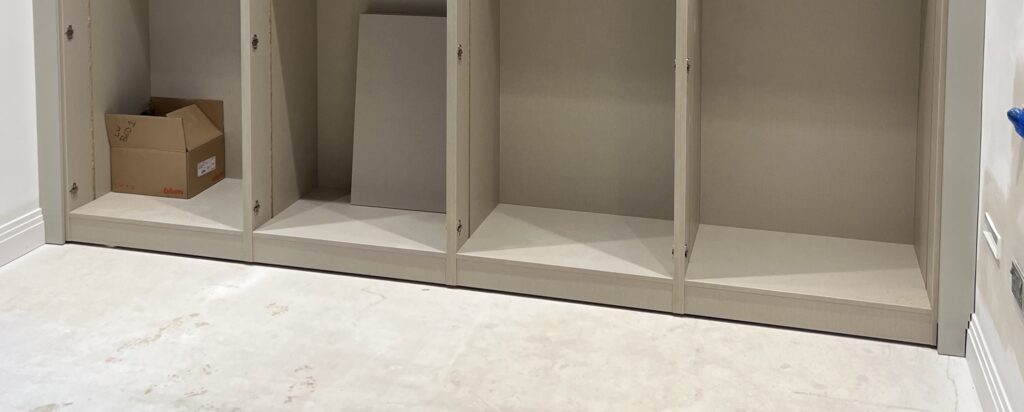
The Issue Homeowners Often Notice — But Can’t Quite Explain
In some fitted wardrobe installations the area beneath the doors appears visually broken or uneven. Instead of a single, continuous line along the floor, there are visible vertical breaks beneath the doors, particularly where multiple wardrobes sit side by side.
These breaks draw the eye downward and can make an otherwise well-designed installation feel unfinished. Rather than appearing as a single, integrated run of furniture, the wardrobes can start to resemble individual units placed next to each other.
This effect is not caused by poor colour choice or incorrect sizing. It is almost always the result of how the wardrobes have been constructed internally.
What Causes This Broken Plinth Appearance
Many fitted wardrobes are built using modular carcass construction. Each individual wardrobe carcass is manufactured with full-height side panels (often referred to as gables) that run all the way down to the floor.
In these systems:
-
each wardrobe carcass has its own base and side panels
-
the plinth is formed within the width of each individual carcass
-
when wardrobes are installed side by side, the carcass gables meet at floor level
Visually, this creates a repeated pattern beneath the doors:
-
carcass side panel
-
internal plinth section
-
carcass side panel
-
then the next wardrobe repeats the same sequence
As a run of wardrobes grows longer these vertical carcass joins become increasingly obvious. Instead of a clean horizontal plinth line, the eye is drawn to the repeated breaks created by the carcass sides.
This is the detail many homeowners instinctively notice, even if they are unsure why it looks wrong.
Why Some Companies Build Fitted Wardrobes This Way
This type of construction is not usually accidental. It is a deliberate choice driven by efficiency.
Building wardrobes with full-height carcasses and internal plinths:
-
simplifies manufacturing
-
speeds up installation
-
reduces finishing work on site
-
suits modular, system-based furniture
From a structural point of view, the wardrobes function perfectly well. However this approach prioritises speed and simplicity over the quality of the visible finish.
When wardrobes are sold as premium, made-to-measure furniture, this compromise becomes much more noticeable.
What Best Practice Looks Like in Fitted Wardrobe Plinth Construction
In a properly specified fitted wardrobe installation, structural construction as well as visible finishing are treated as two separate considerations.
While carcasses may still be built in sections internally, the visible finish at plinth level should always be continuous.
Best practice involves:
-
hiding all carcass-to-carcass joins at floor level
-
finishing the front of the wardrobes with a single continuous plinth face
-
ensuring the plinth aligns cleanly with the wardrobe doors
-
creating one uninterrupted horizontal line along the base of the installation
This approach removes all visible breaks and joins beneath the doors and allows the wardrobes to read as one cohesive, built-in feature rather than a series of individual units.
Regardless of how the internal structure is built, the visible plinth finish should always be continuous.
Modern Designs and Set-Back Plinths
In contemporary fitted wardrobe designs a different visual approach may be used. The finish standard remains the same.
Where a modern, minimalist look is required:
-
carcasses may be constructed on adjustable legs
-
the plinth may be set back from the door line
-
the plinth still runs as one continuous length
By lifting the carcasses and setting the plinth back, side-by-side carcass joins are removed from the visual plane altogether. This achieves a lighter, floating appearance without exposing construction joints.
What matters is not whether the plinth is flush or set back — but that it remains continuous and uninterrupted across the full run.
Why This Detail Matters in High-Quality Fitted Wardrobes
Plinth construction sits at eye level when viewed across a room and becomes especially noticeable in natural daylight.
A broken plinth line can:
-
undermine the visual impact of high-quality doors and finishes
-
make fitted wardrobes feel modular rather than bespoke
-
draw attention to construction shortcuts rather than craftsmanship
Because fitted wardrobes are a long-term, built-in feature of a home these details tend to stand out more over time rather than fade into the background.
What Homeowners Should Ask Before Ordering Fitted Wardrobes
To avoid disappointment, homeowners should ask clear, specific questions about plinth construction at the design and quotation stage.
Useful questions include:
-
Will the plinth be finished as one continuous panel across the full run?
-
Will any carcass joins be visible beneath the doors?
-
Does the plinth sit flush with the doors or set back as a single piece?
-
How are multiple wardrobes finished where they sit side by side?
A professional fitted wardrobe company should be able to explain this clearly and show examples of how plinths are finished on completed installations.
Plinth Construction as Part of the Bigger Picture
Plinth detailing is just one of many construction decisions that influence how fitted wardrobes look and perform once installed.
For a broader explanation of how fitted wardrobes are designed, built and installed as a complete system, see our main guide:
Frequently Asked Questions About Fitted Wardrobe Plinth Construction
Visible joins at plinth level usually occur when fitted wardrobes are built using individual carcasses with internal plinths. When these carcasses are installed side by side, the carcass side panels meet at floor level, creating repeated vertical breaks instead of one continuous plinth line.
Not necessarily poor functionality, but it is a sign of a lower finishing standard. While wardrobes constructed this way can function perfectly well, visible carcass joins at plinth level indicate a modular construction approach rather than a fully finished, built-in result.
Best practice is to finish fitted wardrobes with a single continuous plinth face across the full run. This hides carcass joins, creates a clean horizontal line and allows the wardrobes to read as one integrated installation rather than separate units.
Yes. In modern or minimalist designs carcasses may be raised on legs and the plinth set back to create a lighter appearance. However, the plinth should still run as one continuous element so that carcass joins are never visible at floor level.