

Why Fitted Wardrobe Colours Don’t Always Match
Fitted wardrobes are designed to look seamless once installed. However in some cases, homeowners notice that the colour of the doors, panels or surrounding pieces doesn’t appear to match perfectly.
This usually happens because different parts of a fitted wardrobe are made from different materials, finished using different processes and viewed under varying lighting conditions once installed.
Understanding how fitted bedrooms and fitted wardrobes are constructed. How the individual components work together makes it much easier to see why this happens and when it should, or should not be a concern.
Understanding the Main Components of a Fitted Wardrobe
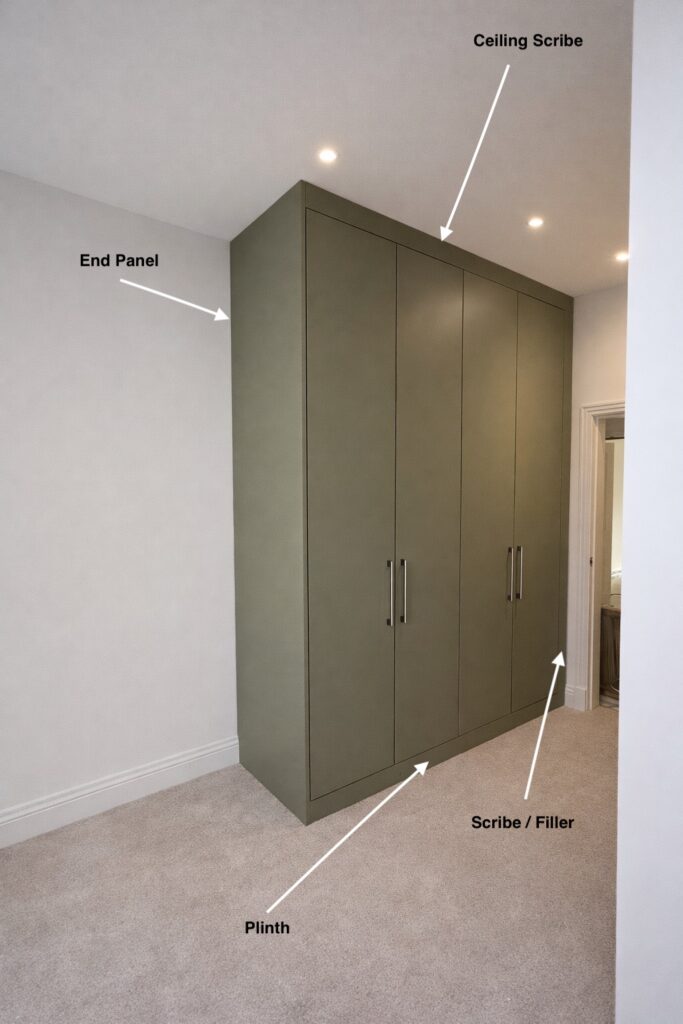
Although fitted wardrobes are designed to appear as a single, built-in installation they are made up of several separate components. Each part has a specific role in how the wardrobe fits, functions and looks once installed.
Understanding these components is key to understanding colour consistency.
Why These Components Matter for Colour Consistency
Although all of these elements come together to form one fitted wardrobe installation, they are not always manufactured or finished in the same way.
Where visual consistency is a priority, visible components such as doors, surround panels, scribes, end panels, plinths and top panels are typically specified using compatible materials and finished using the same process.
However, in some installations:
-
different board materials may be used for surrounding panels
-
doors and panels may be finished using different methods
-
components may be produced or finished at different stages
When visible parts are made from different materials or finished differently, they can reflect light in different ways. Even when colours are described as “matched”, subtle differences in tone or texture can become noticeable once everything is installed together.
This is often where fitted wardrobe colour matching issues begin.
Fitted Wardrobe Doors
The doors are the most visible part of a fitted wardrobe. They are typically factory manufactured and finished under controlled conditions.
Depending on the fitted wardrobe specification, doors may be:
-
vinyl wrapped
-
painted or sprayed
-
lacquered
-
laminated
Because doors are usually produced as a matched set, they tend to have a very consistent colour and finish. For most homeowners, the doors become the visual reference point that the rest of the wardrobe is compared against.
Surround Panels, Scribes and Filler Pieces
Surround panels (often referred to as scribes or filler panels) are used to close the gaps between the wardrobe and the surrounding walls or ceiling.
These components are essential because no room is perfectly straight or level. Walls may lean, ceilings may dip, and floors may rise or fall across the width of a room.
Surround panels are used to:
-
tightly fit wardrobes against uneven walls and ceilings
-
neatly work around skirting boards, coving, picture rails and other architectural features
-
prevent doors from fouling walls, handles or trims when opened
-
allow wardrobe doors to open fully, often beyond 90 degrees, which is important for internal drawers and pull-out features
From a visual point of view, surround panels play a major role. When designed to sit flush with the doors, they create a framed, built-in appearance. In some designs, filler panels are set slightly back behind the doors, which can reduce material costs and help disguise colour variation, but often results in a less seamless finish.
End Panels
End panels are used when the side of a fitted wardrobe is visible in the room rather than hidden against a wall.
These panels can be structural or decorative and are often manufactured separately from the doors. Where ceiling height allows, a single floor-to-ceiling end panel provides the cleanest and most integrated result.
When neatly scribed around skirting boards, coving or other features, end panels help the wardrobe feel like part of the room itself rather than a piece of furniture placed into it. Well-fitted end panels also eliminate dust gaps and visual breaks that can detract from the fitted appearance.
Plinths
Plinths form the base of a fitted wardrobe and allow the installation to be levelled on uneven floors.
The plinth sits below the doors and when properly scribed to the floor profile, creates a consistent shadow gap between the bottom of the doors and the top of the plinth once the wardrobe doors are adjusted and levelled.
Even when flooring such as carpet is fitted after installation, plinths should still be accurately scribed rather than simply hidden, filled or caulked. Poorly fitted plinths are often one of the first areas where an installation begins to look untidy over time.
Ceiling Scribes and Top Panels
Ceilings, like walls and floors, are rarely perfectly level. Ceiling scribes or top filler panels are used to close the gap between the top of the wardrobe doors and the ceiling.
These panels are shaped to follow the ceiling line and help create a consistent shadow gap above the doors. Without them, uneven gaps can become very noticeable once the wardrobe is installed and viewed under natural or directional lighting.
Why Many Homeowners Don’t Realise There’s a Colour Difference
Many homeowners are unaware that colour differences can occur because they are rarely obvious during the design or quotation stage.
In most cases, the issue isn’t hidden deliberately. It is simply not explained clearly, or it isn’t noticeable until the wardrobes are fully installed and viewed in the finished room.
There are several common reasons for this.
Showrooms and Samples Focus on Doors, Not the Full Installation
Showroom displays typically highlight wardrobe doors, colour samples and available finishes. Surround panels, scribes, end panels and plinths are rarely shown in full context, even though they form a large part of the visible installation in real homes.
Samples Represent One Component, Not All Materials
Colour samples often relate only to the fitted wardrobe doors. Other visible parts of the wardrobe may be made from different materials, even when specified as the same colour. This difference is not always apparent from small samples viewed in isolation.
Lighting Conditions Are Very Different in Real Homes
Showroom lighting is designed to be bright and even. In contrast, real homes have natural daylight, shadows and artificial lighting that changes throughout the day. These conditions can reveal subtle colour differences that were not noticeable earlier.
“This Is Just How Fitted Wardrobes Are Done”
Some homeowners are told that using different materials for doors and surrounding panels is standard practice. Without further explanation, it is easy to assume this will not affect the final appearance — particularly if alternatives are not discussed.
Cost-Led Decisions Are Not Always Fully Explained
In some installations, wardrobe doors may be vinyl wrapped while surrounding panels and end panels are manufactured from colour-matched MFC. Although these products are designed to coordinate, they are finished differently and reflect light in different ways.
Once installed together, this can result in a subtle but noticeable tonal variation.
When Colour Differences Usually Become Noticeable
In many cases, colour differences only become apparent once:
-
the wardrobes are fully installed
-
the room is viewed in natural daylight
-
artificial lighting is added
-
the installation is seen as a complete whole rather than individual parts
Some homeowners may never notice the difference at all. Others may assume the variation is intentional or unavoidable. However, when different materials are used across visible components without clear explanation, the result can be unexpected.
What Is Considered Best Practice in Fitted Wardrobe Colour Matching?
In a professionally specified fitted wardrobe, visible components are typically designed to match as closely as possible.
This usually means that:
-
doors
-
surround panels and scribes
-
end panels
-
plinths
-
ceiling scribes or accessory panels
are made from the same base material and finished using the same process, where visual consistency is important.
This approach helps ensure that all visible surfaces reflect light in a similar way and age consistently over time.
When Differences Are Acceptable
There are situations where using different materials or finishes is entirely appropriate, for example:
-
when a contrasting surround is part of the design
-
when budget constraints are clearly discussed and agreed
-
when structural requirements dictate a different substrate
In these cases, the key factor is clarity. Homeowners should understand which parts are different, why those decisions have been made and how they may affect the finished appearance.
Where Problems Can Arise
Issues tend to occur when:
-
different materials are used without explanation
-
samples only represent the doors
-
colour matching is assumed rather than confirmed
In these situations the installation may meet functional requirements, but the final appearance may fall short of expectations. Particularly once viewed under real lighting conditions.
Making an Informed Comparison
Fitted wardrobes are intended to be a long-term, built-in feature of a home. Understanding how colour consistency is achieved and where compromises can occur allows homeowners to compare providers on more than just price or brochure images.
For a broader explanation of how fitted wardrobes are designed, constructed and installed as a complete system, see our main Guide to Fitted Wardrobes page:
Frequently Asked Questions About Fitted Wardrobe Colour Matching
Colour differences usually occur because different parts of a fitted wardrobe can be made from different materials or finished using different processes. Even when colours are specified as “matched”, variations in texture, sheen as well as light reflection can make differences more noticeable once installed.
Some very, very minor variation can be normal, particularly where different materials are used. However, where visual consistency is important, best practice is to specify matching materials and finishes across all visible components. Any expected variation should be explained in advance.
Where a seamless, built-in appearance is the goal, scribe panels, end panels and doors are typically made from the same base material and finished using the same process. Differences may be acceptable if they are part of a deliberate design choice or clearly discussed beforehand.
The best way to avoid unexpected colour differences is to ask how all visible components will be made and finished, review samples that reflect the final materials used, and consider how lighting in your home may affect the finished appearance.